 Scout
Company insights, right in Slack.
Scout was a teammate in Slack I designed and built for Klue’s sellers.1 It turned a sales call into insights delivered in the chat sellers already had open.
Project facts
- Where
- Klue
- When
- Q2 20251
- Role
- Led the design sprint, then designed and built Scout
- Built with
- Replit, JavaScript, GPT‑4.1, Slack canvases, Figma2
- Team
- Sprint: the design team and the VPs of Product and Engineering. Scout: me.3
- Shown to
- Board of directors
- About Klue
- Software that helps companies gather competitive intelligence and share it with their sales teams
- Scope
- The sprint, the Figma prototype, the content and canvases, the prompts, the bot, and the live demo for the board
15
scripted steps the demo could follow, with open-ended questions woven in.
10
prompts in the pipeline, one for each step from the call to the insight.
1
sales call was used to generate every insight Scout delivered.
Get to know Scout.
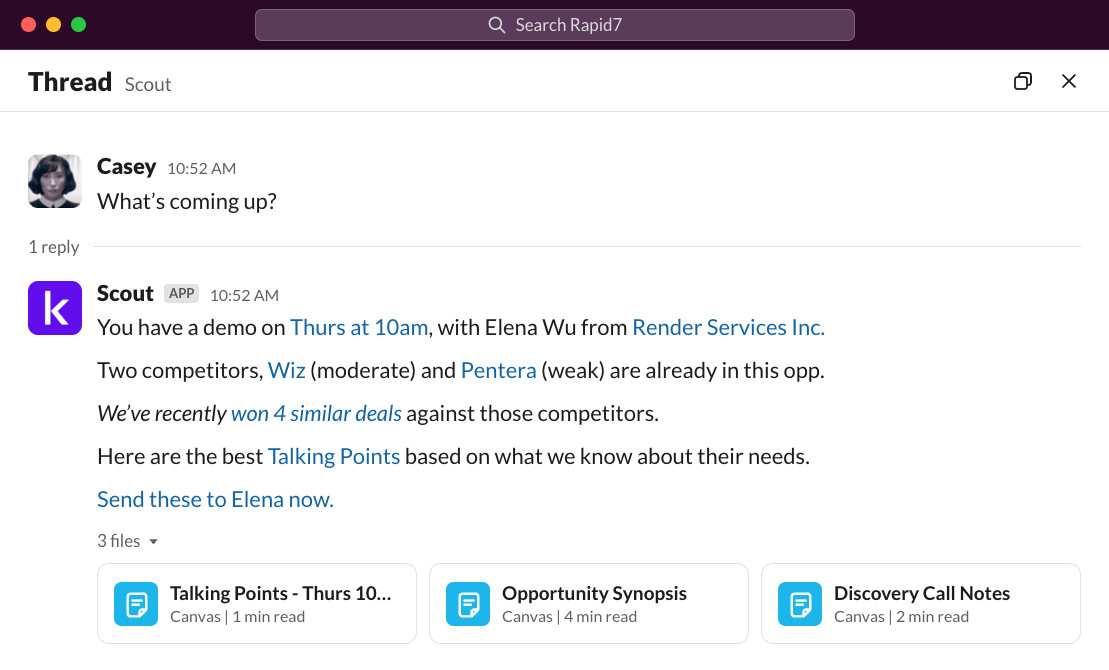
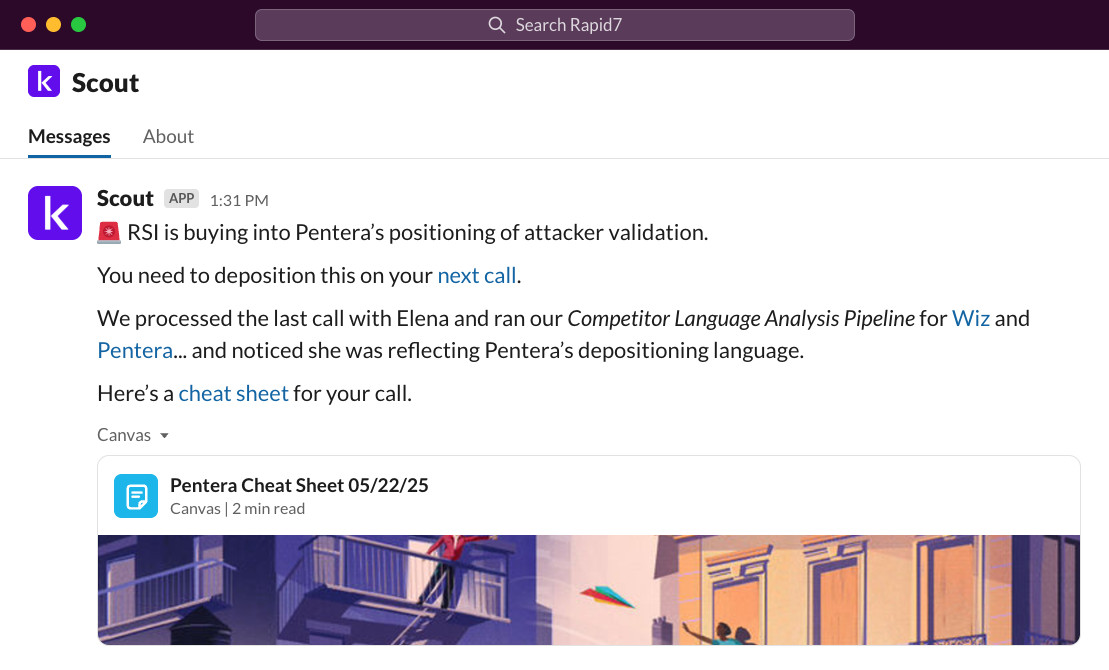
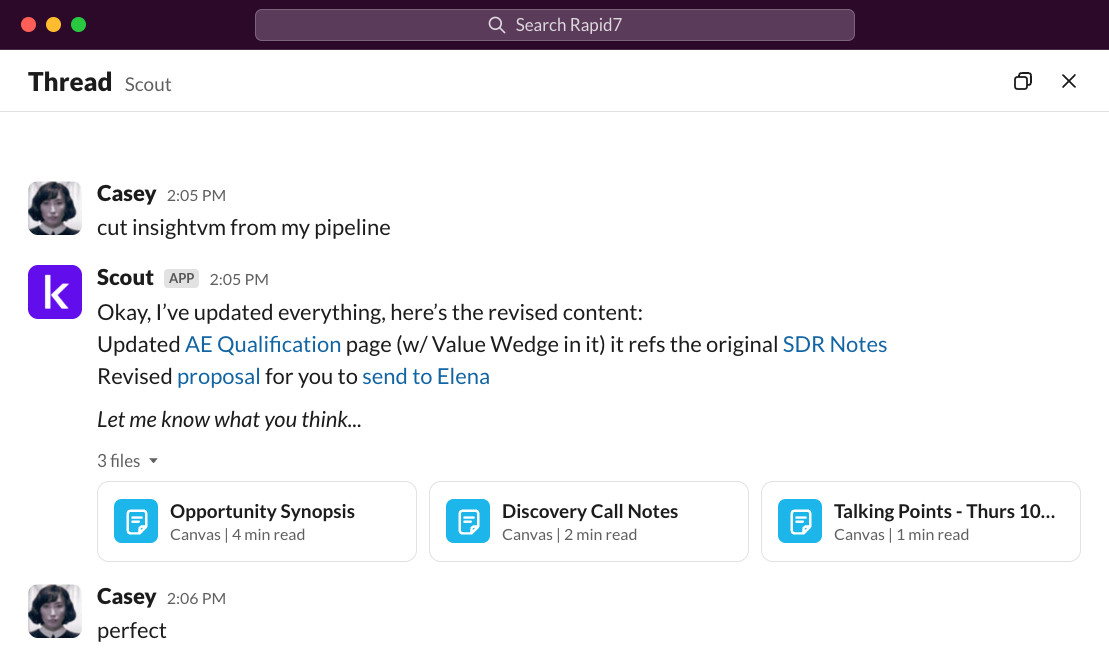
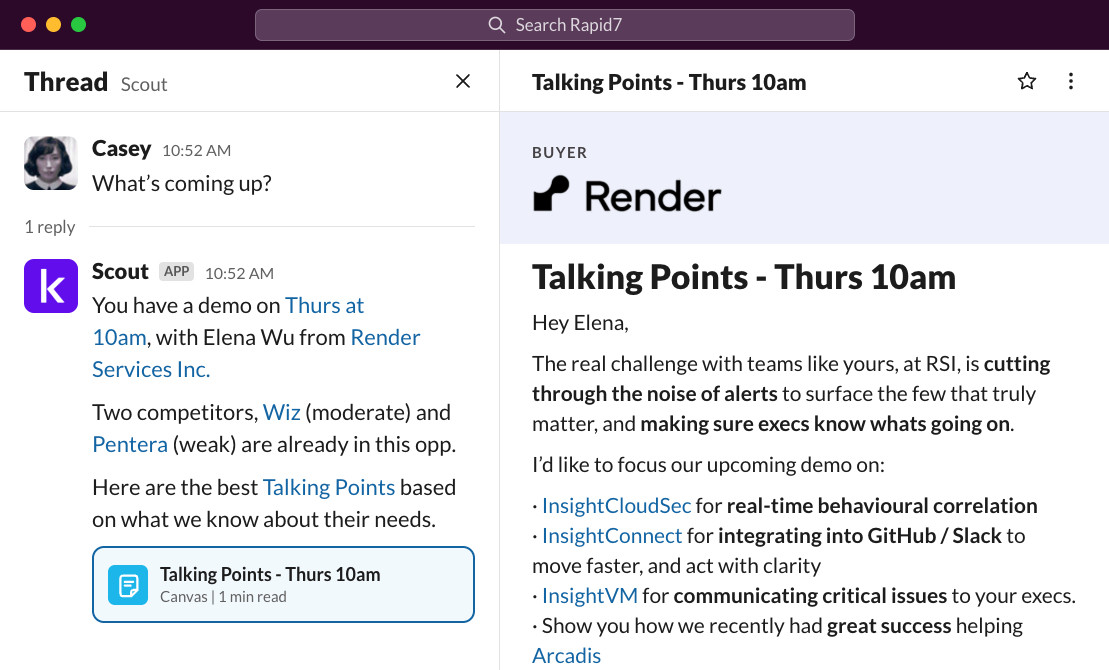
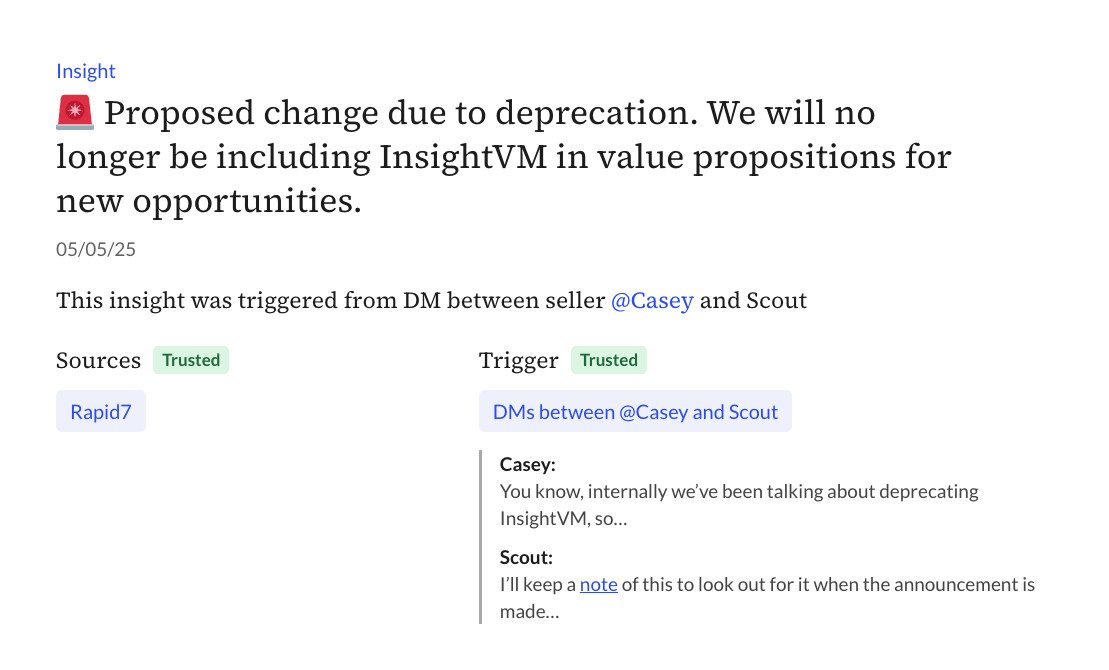
The problem
Sellers wouldn’t open another app.
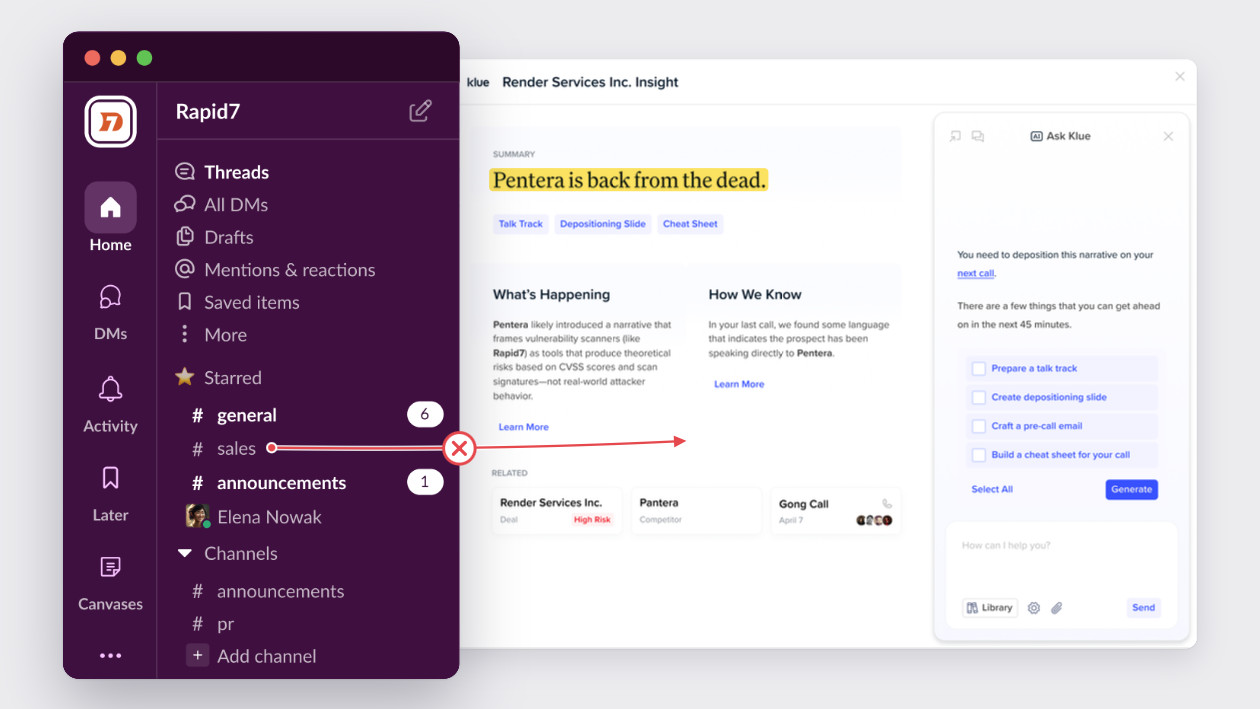
Klue’s insights lived in its own app. To use them, people had to leave the conversation they were in and go looking. Before betting on an overhaul of the product, Klue had one question to answer: could it deliver the same value inside another tool’s interface?
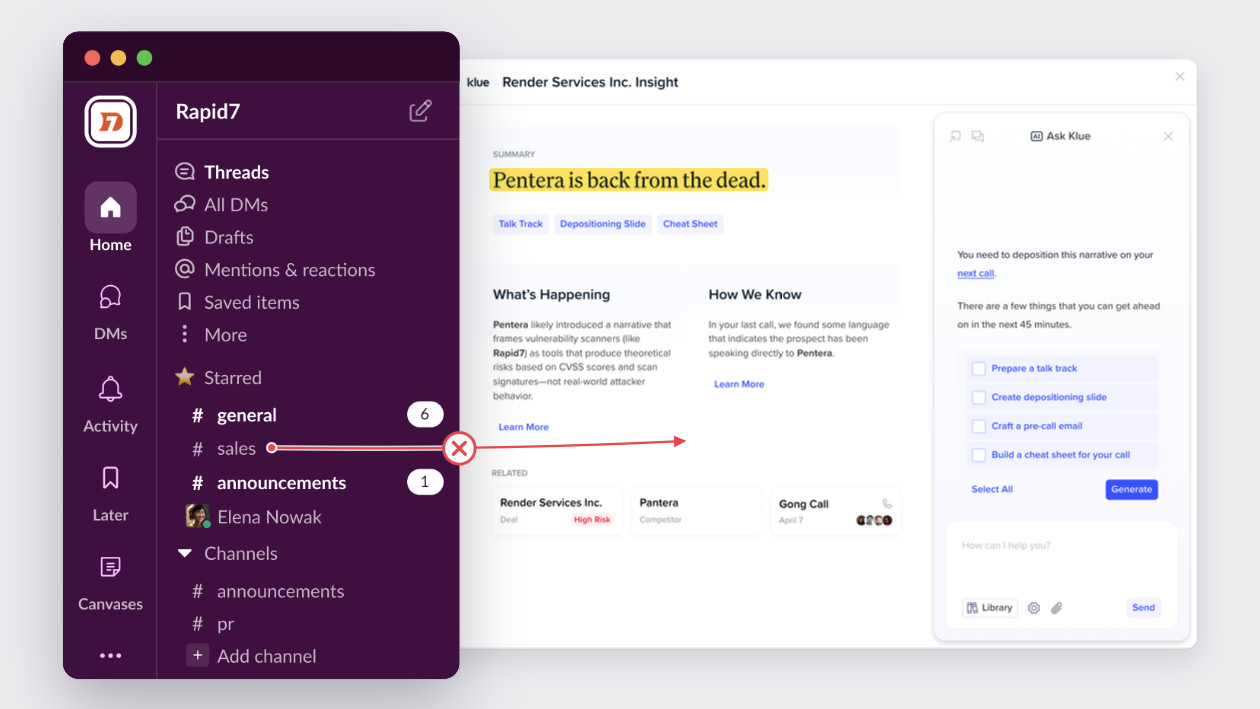
Leaving Slack to find an insight. Klue had the answer; sellers had to open Klue to see it.
What I owned
I led the sprint, designed it, built it, and took it to the board.
I carried Scout from a sprint idea to a working bot in front of Klue’s board.
-
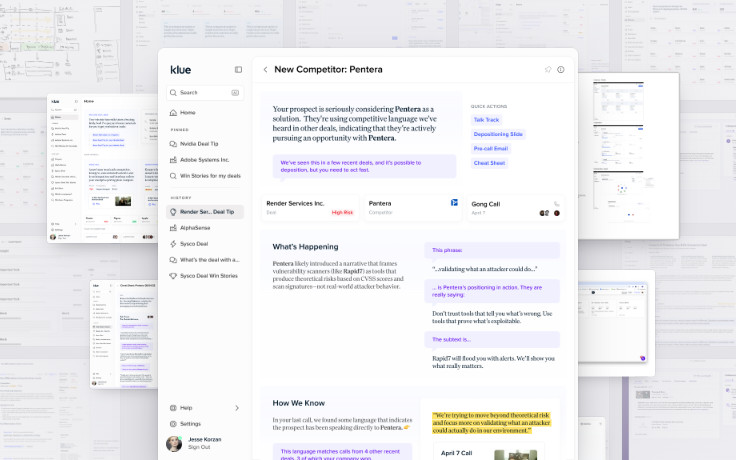
The sprint.
I led a broad design sprint to rethink where Klue’s product was going.
-
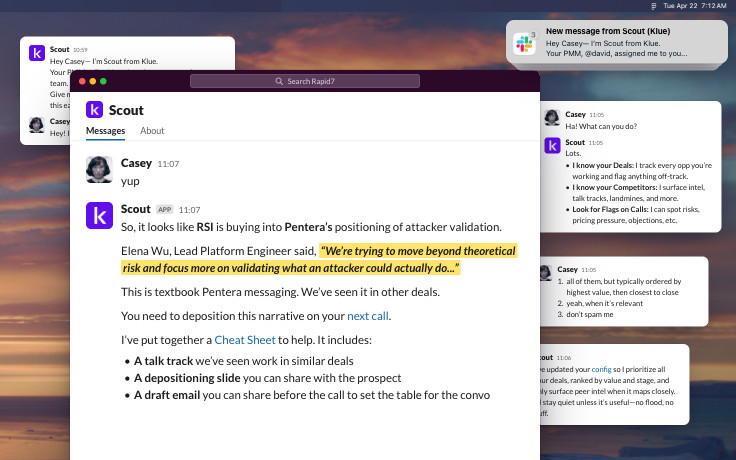
The Figma demo.
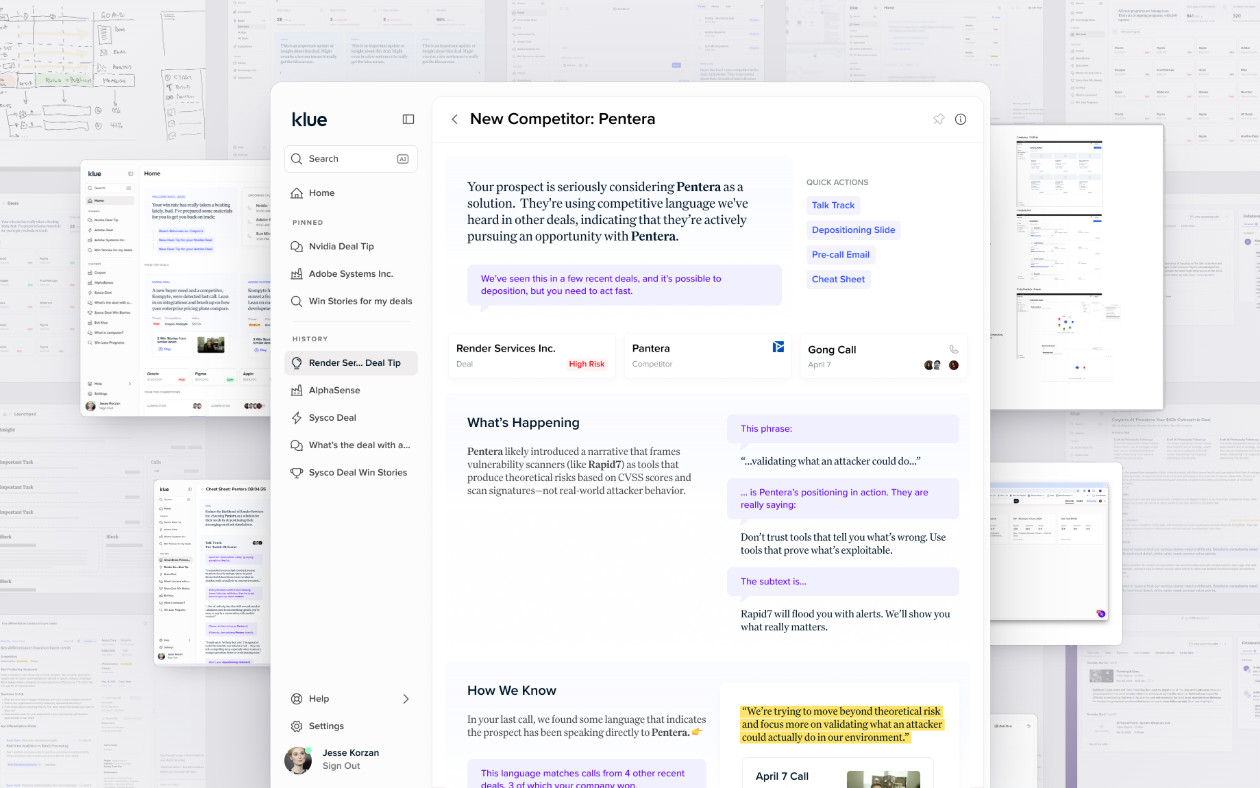
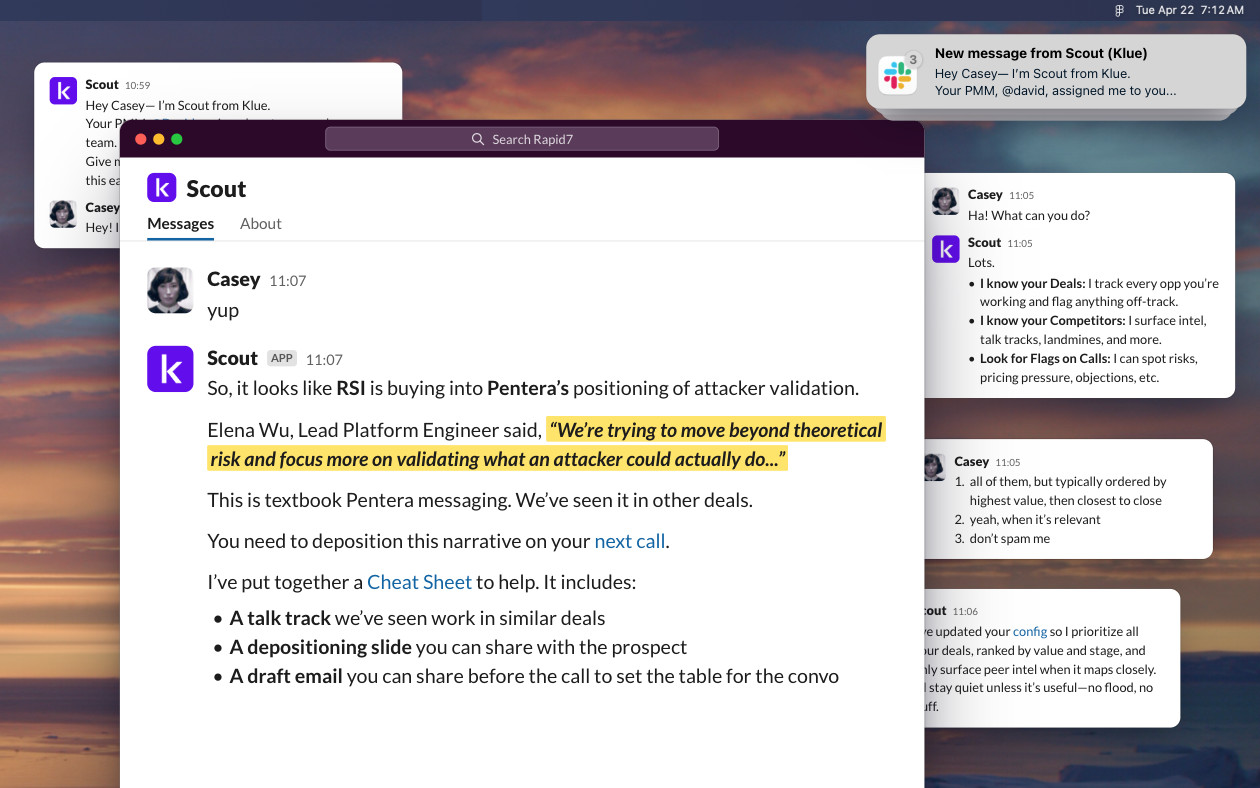
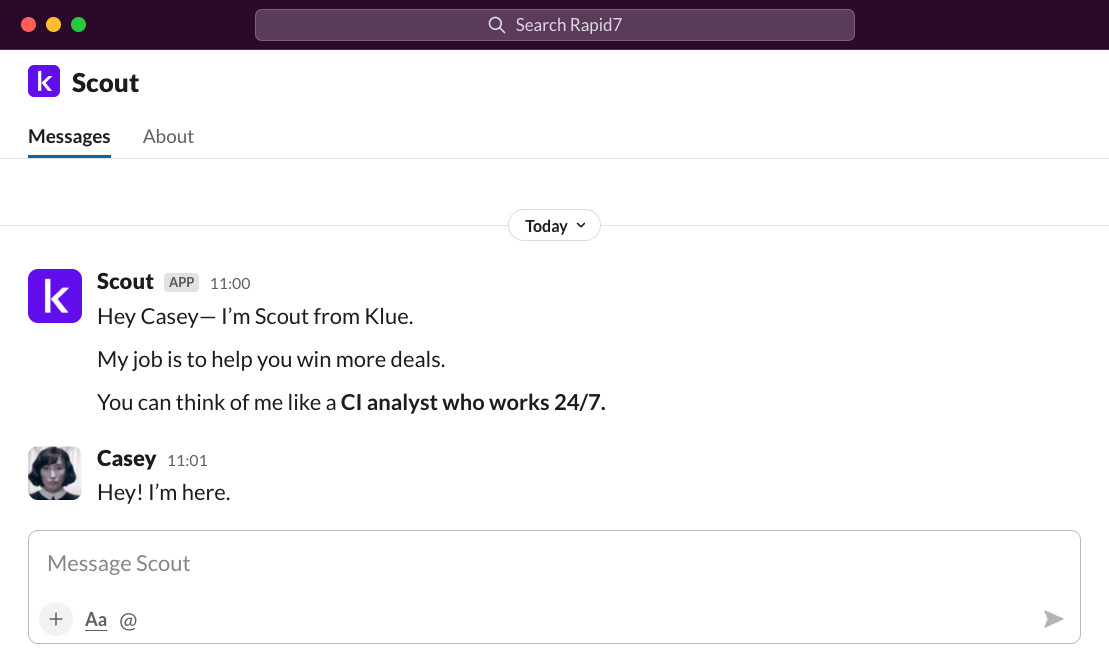
I designed Scout in Slack, scripted end to end: how it introduced itself, got set up and delivered its first insight.
-
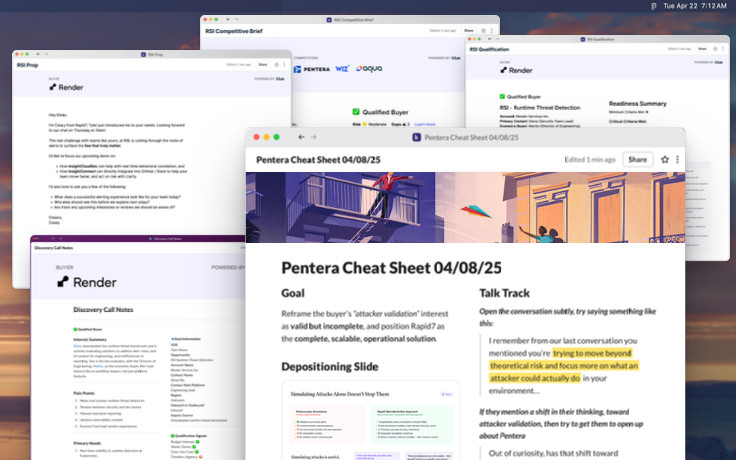
The content.
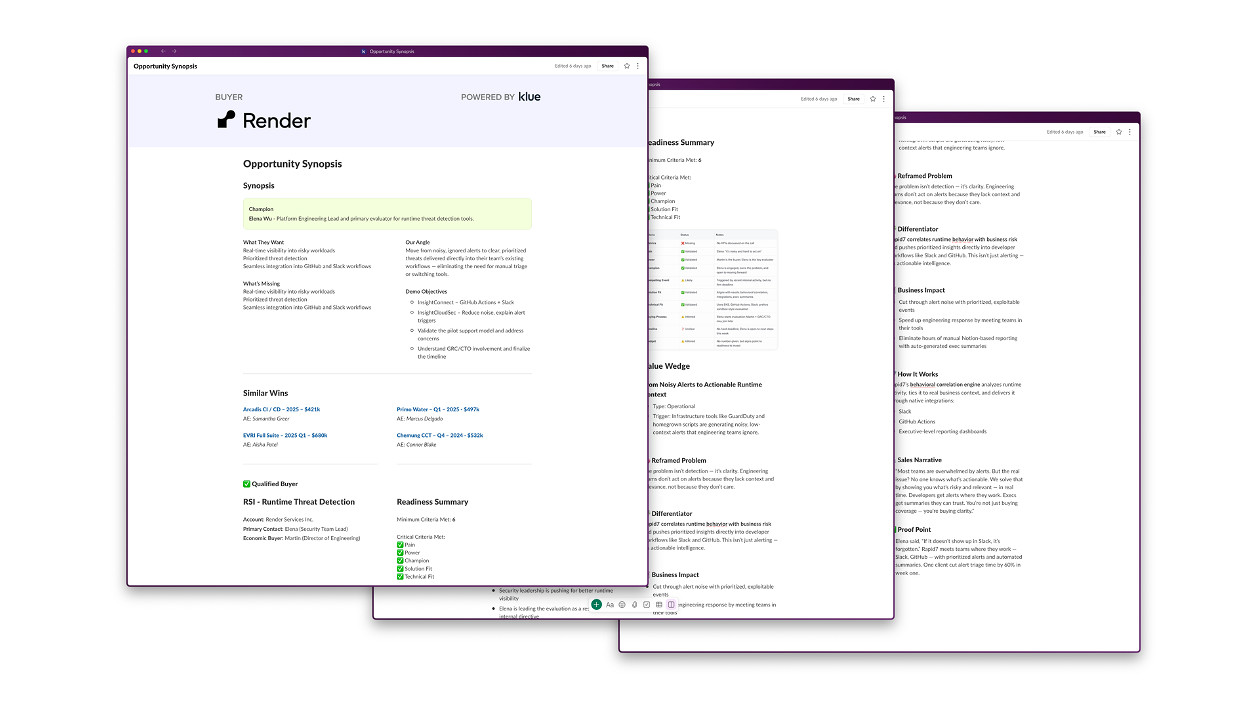
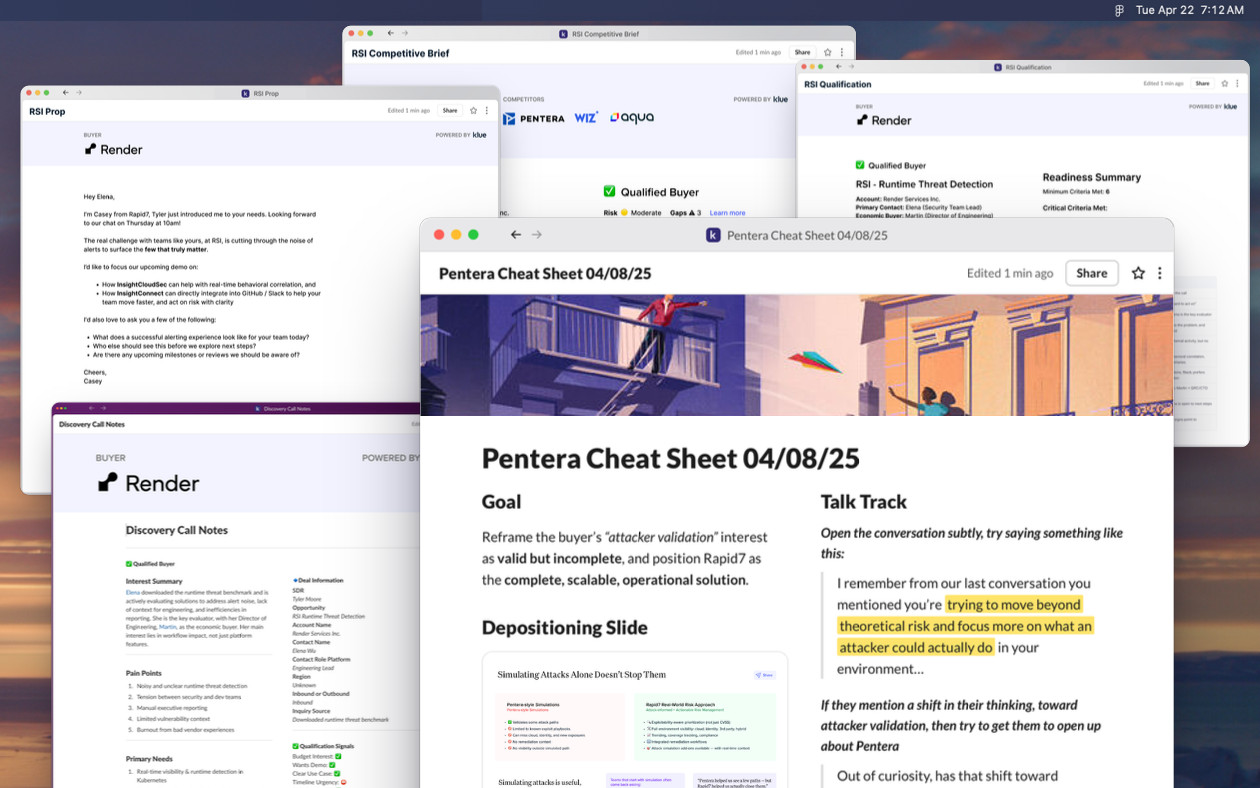
I invented and generated the documents Scout handed sellers: deal briefs, qualifications, proposals and cheat sheets, each a Slack canvas.
-
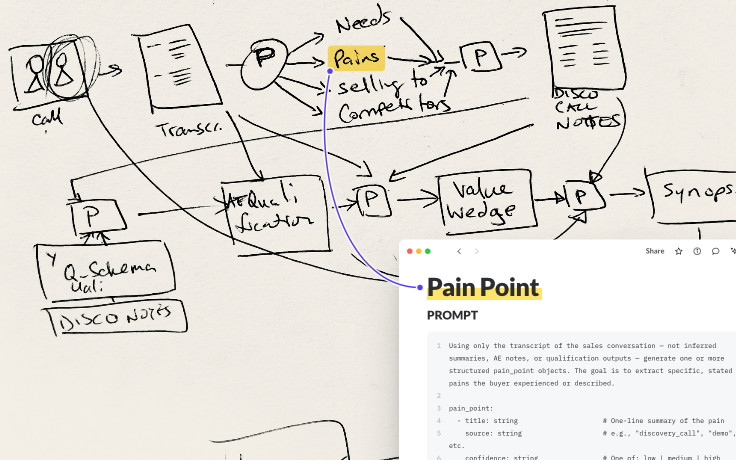
The brain.
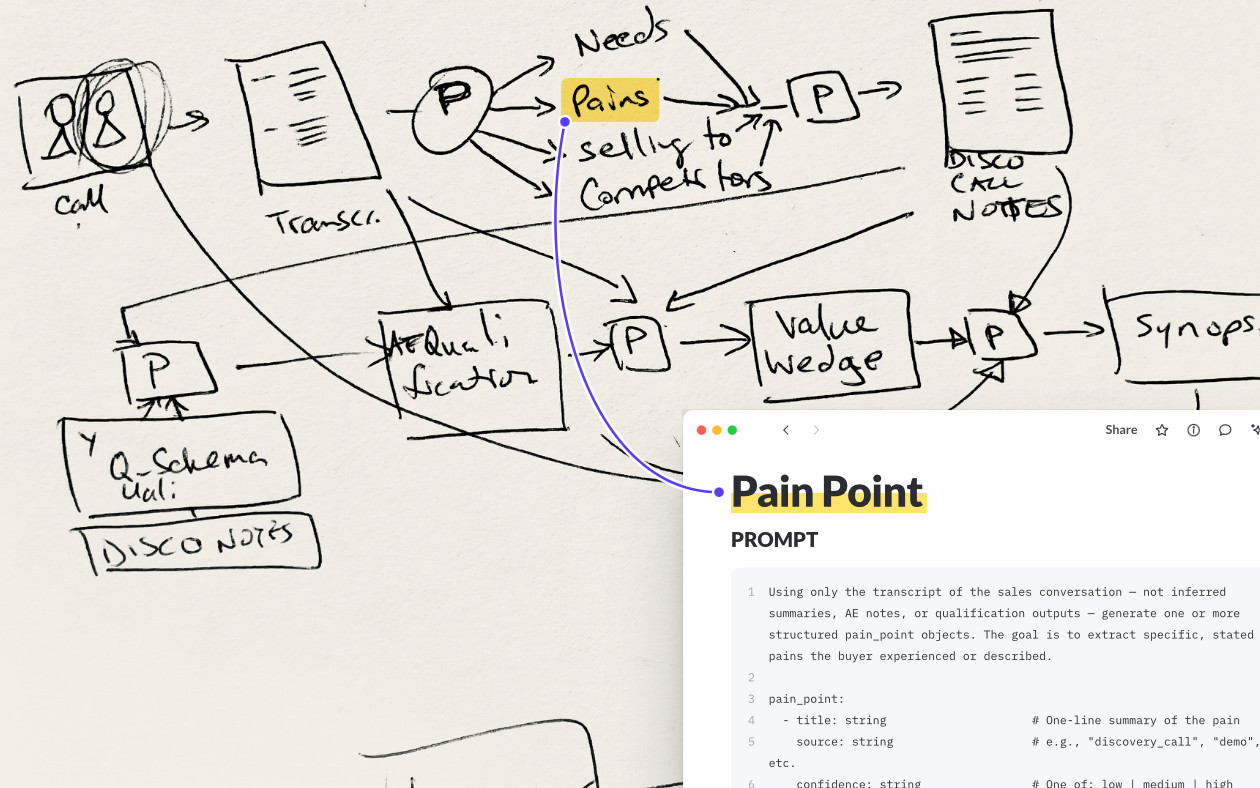
I mapped how one sales call becomes all of that, and wrote a prompt for every step.
-
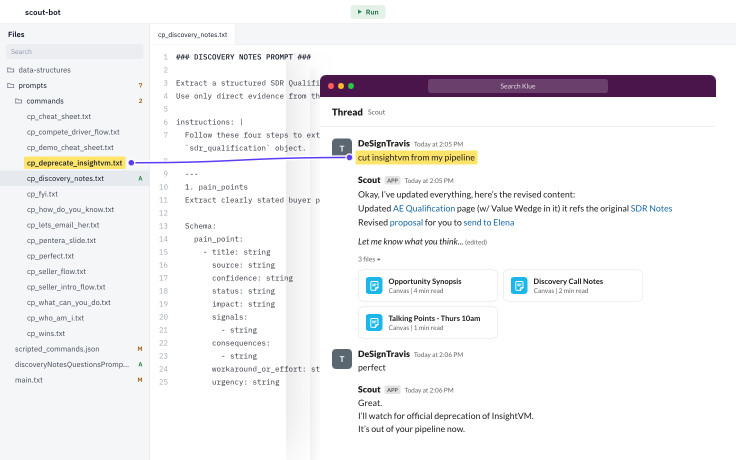
The bot.
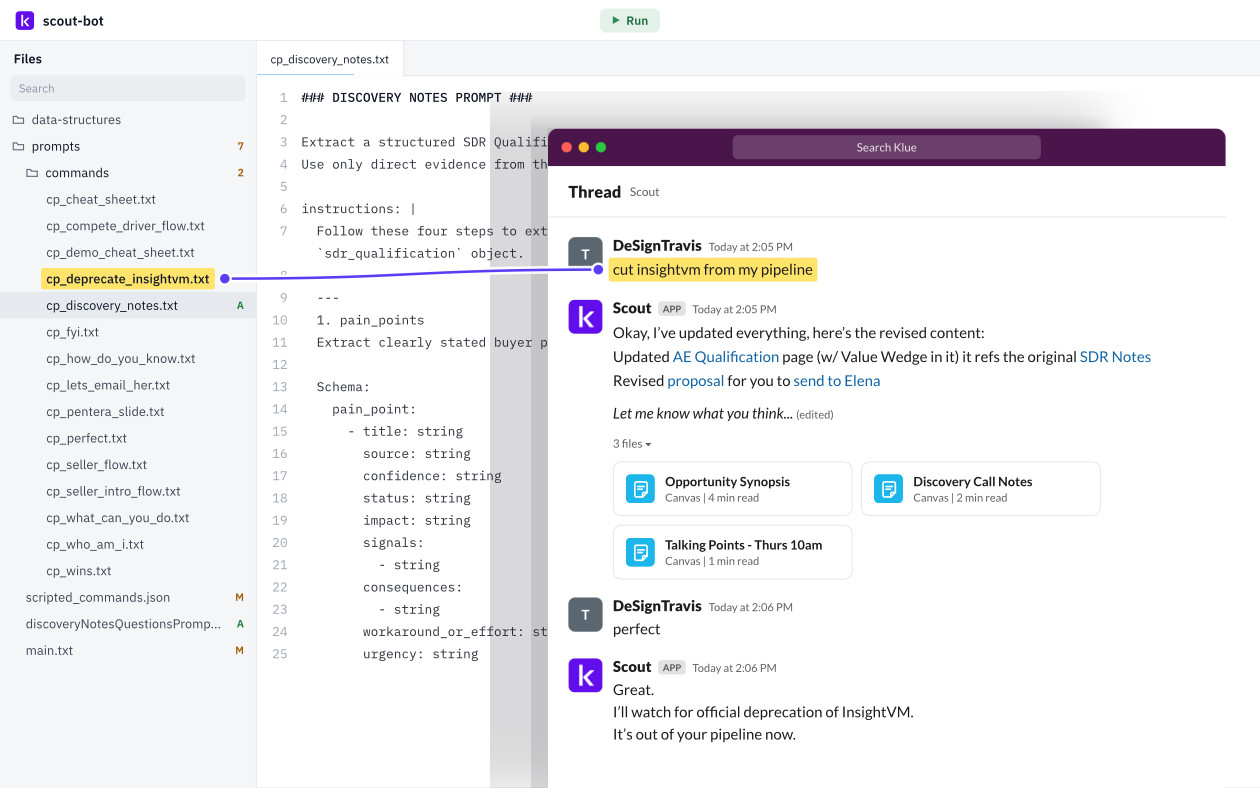
I built it, working through every edge of the Figma demo until it gave the answers people actually wanted.
-
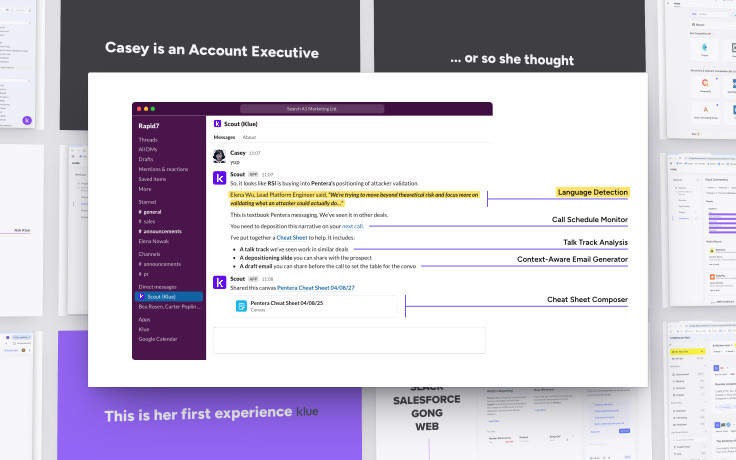
The board.
I presented Klue’s board with the bigger story, insights wherever sellers work, and ran Scout live as the proof.
The solution
Every message, an insight.
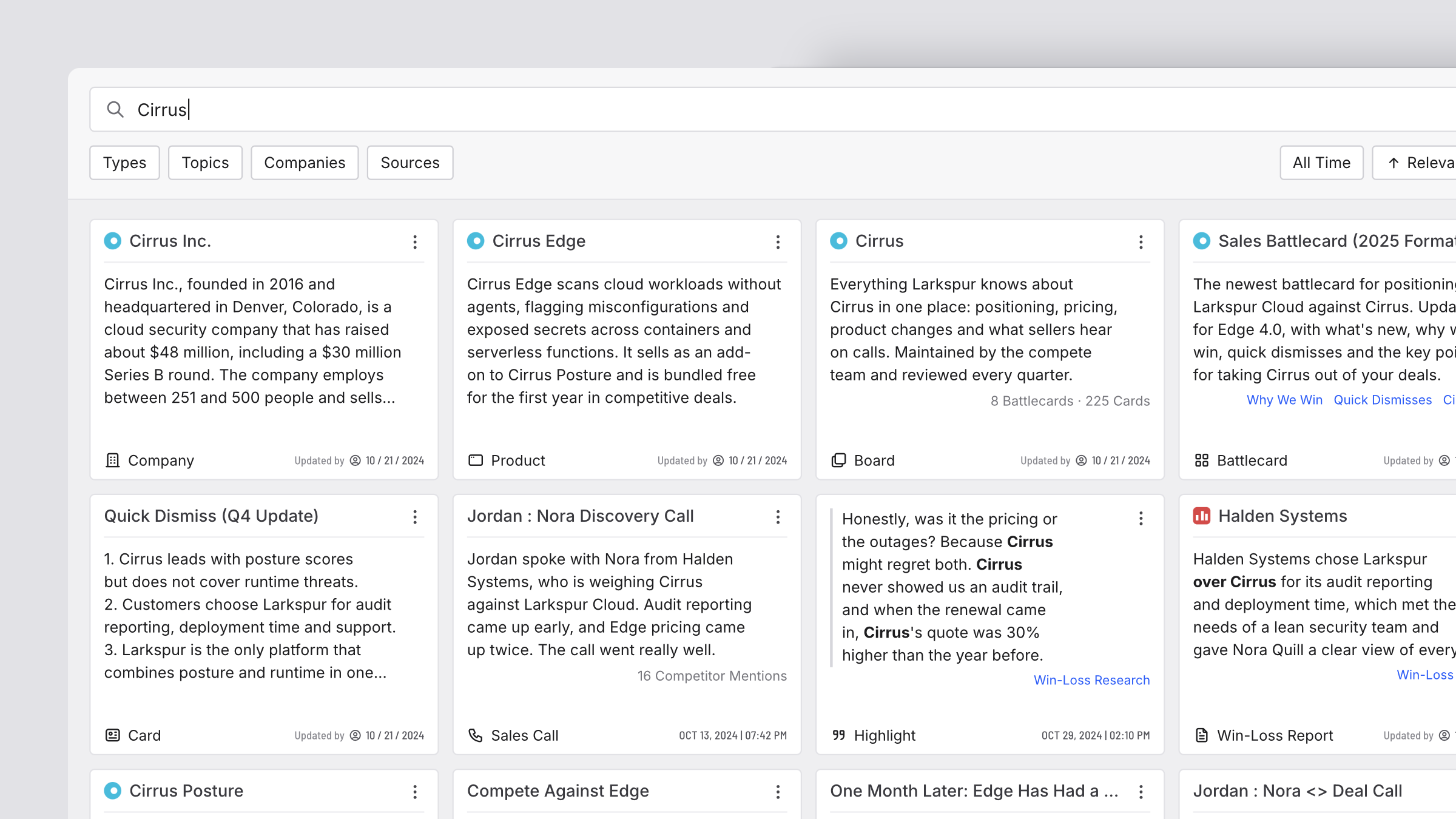
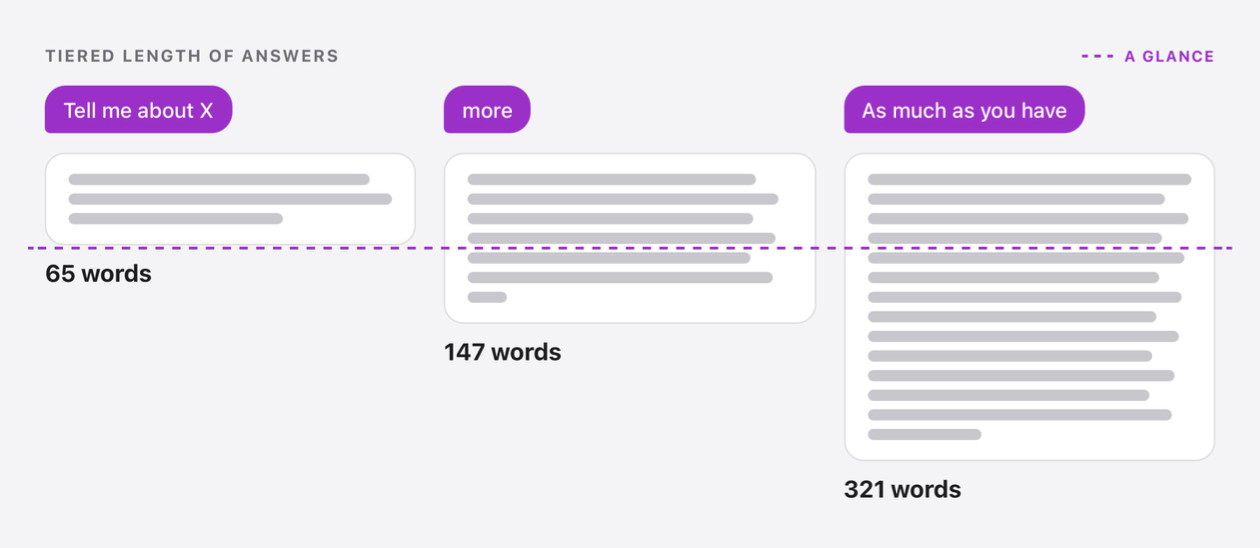
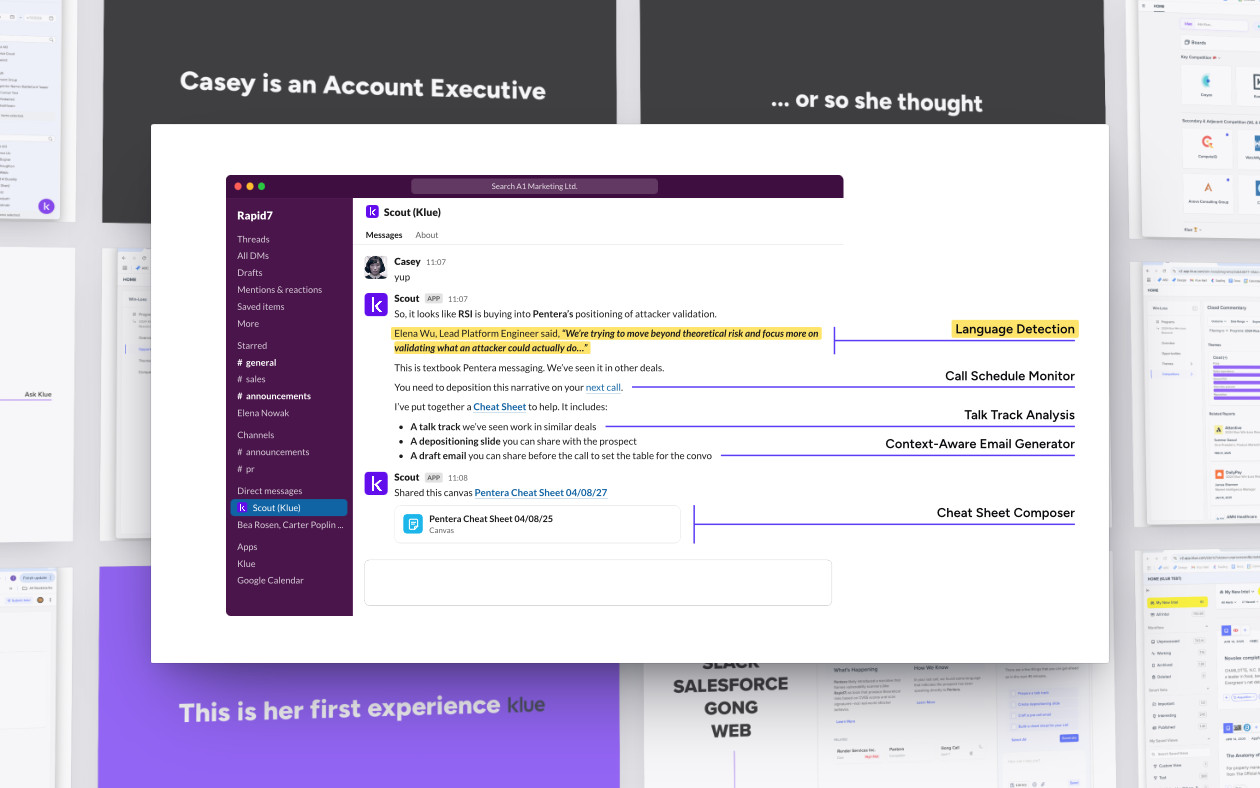
An insight was a statement, the intel behind it and the action to take. Scout delivered them in Slack, with the documents behind each one a click away. A mockup couldn’t show what it was like to ask it something, so I built it, and it answered back.
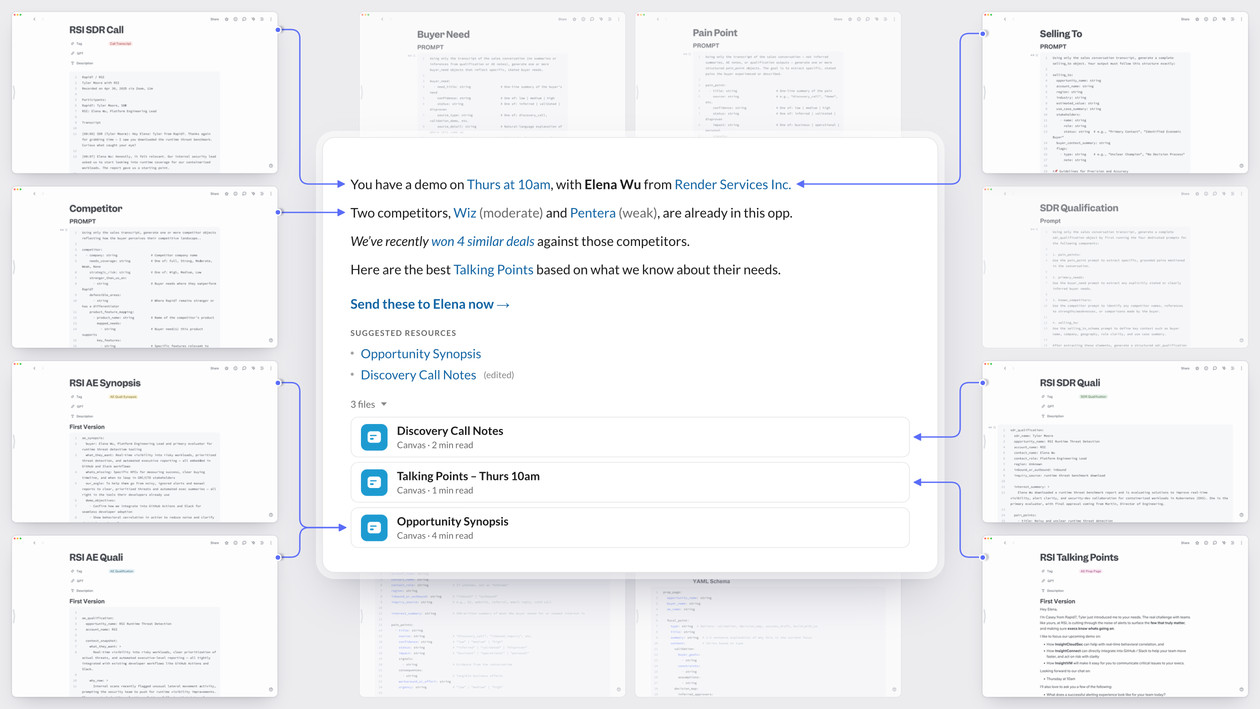
Every line of the briefing, traced back to a prompt. The meeting, the buyer, the competitors and each canvas came from prompts that read one sales call.
Underneath, part one: the knowledge
Knowledge derived from one call.
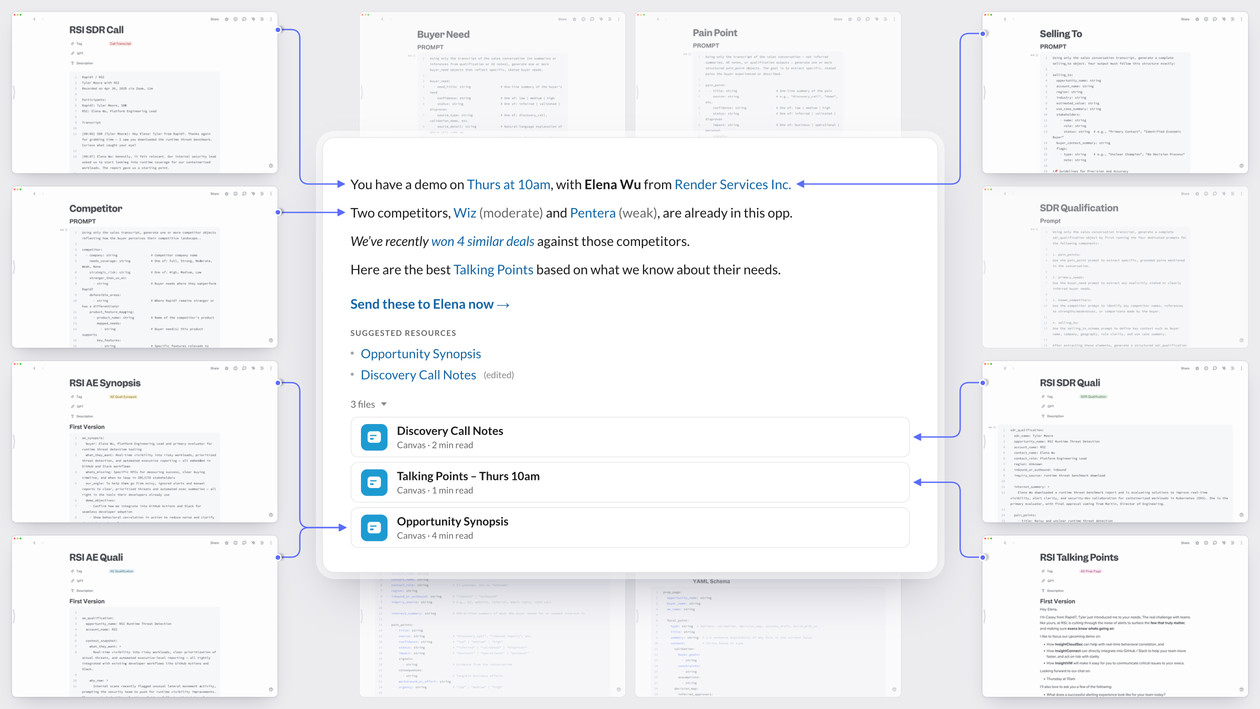
Every insight Scout delivered came from one sales call. Specialized prompts read only the transcript and pulled out the buyer’s needs, the competitors, who it was selling to and the pain points, as structured data. Qualification notes, the value wedge and the talking points were built on top, and every insight drew on all of it.
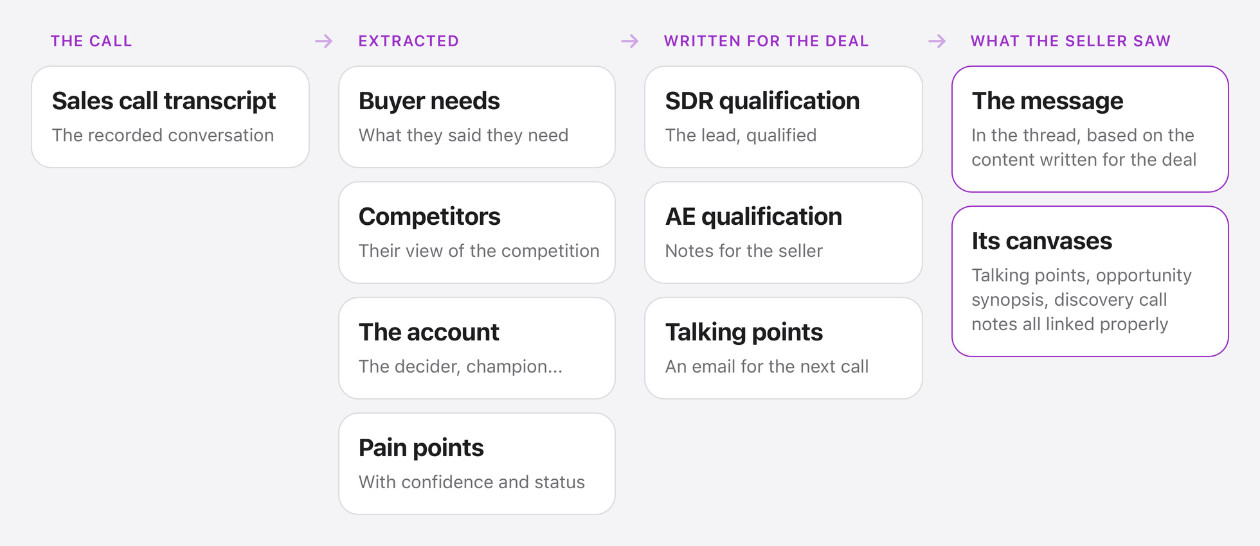
The layers under the briefing message, from the call transcript up.
Underneath, part two: the proof
Feasibility, proven one prompt at a time.
Building the pipeline was conversation design and feasibility at the same time. Each step was a real prompt that generated real answers based on real content. I used that content for the Figma demo, and showed engineers how I structured the pipeline to generate all the data that Scout needed to give good answers.
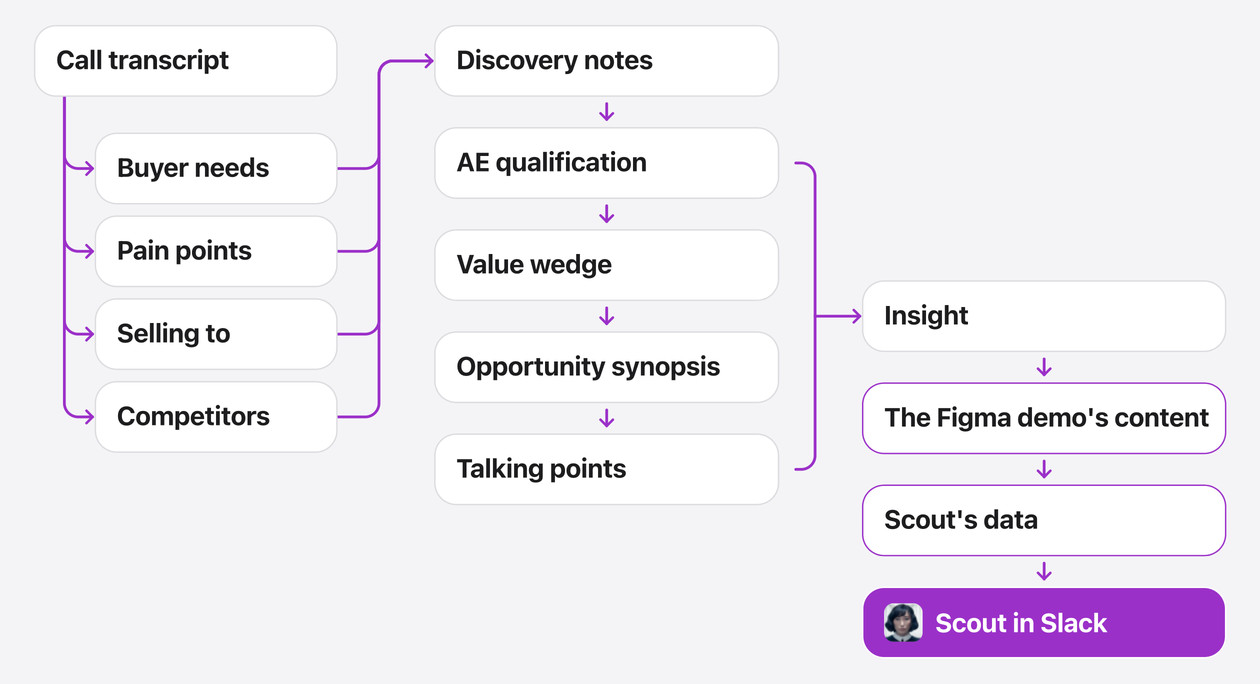
Each step proven before the next. Outputs that held up against the call became the Figma demo’s content, and then Scout’s data.
Tough calls
Only the conversation was real.
I had to move quickly on this one. So a majority of the concept stayed in Figma. And a vision video had to wait. I built what mocks couldn’t show: talking to it.
The bot first, the video after.
A video couldn’t take a question from the board, so I built Scout first, then filmed it to show everyone else.
Guided, not open-ended.
The board demo had to land the same way every time, so trigger words moved Scout through a set story. Questions off that path still went to the model.
Slack only.
The board saw Salesforce, Gong and the web as designs; the conversation would have worked the same way in each.
The call as the only source.
Each prompt read the call transcript and nothing else. That limited what it could say, but every claim could be checked against the call.
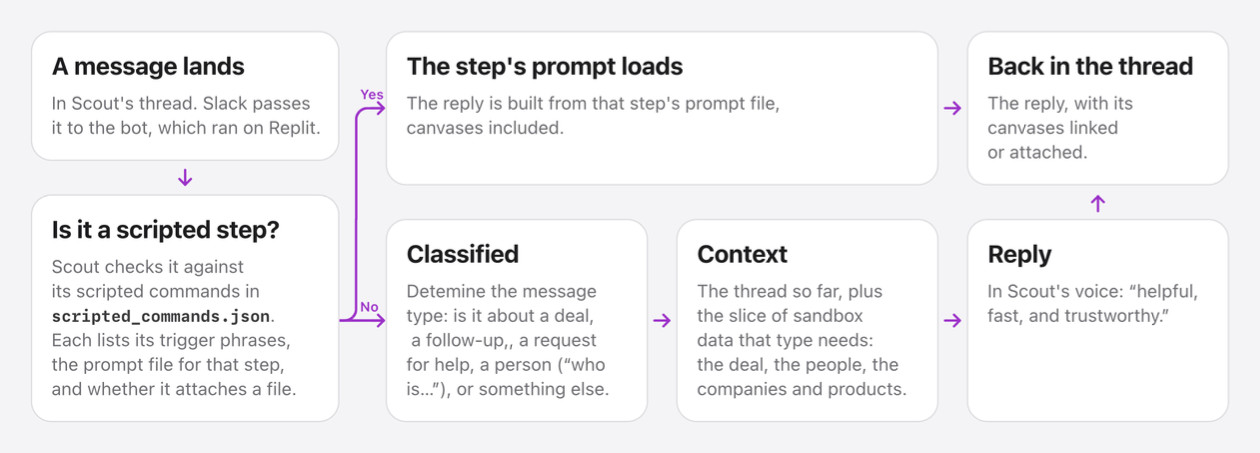
How Scout handled a message, from the thread and back.
The outcome
Klue started building for chat.
In May I ran Scout live for Klue’s board of directors. It landed at a time when there was scrutiny over the direction the company was taking. It helped kick off Klue’s plan to deliver insights inside the tools its customers already use.
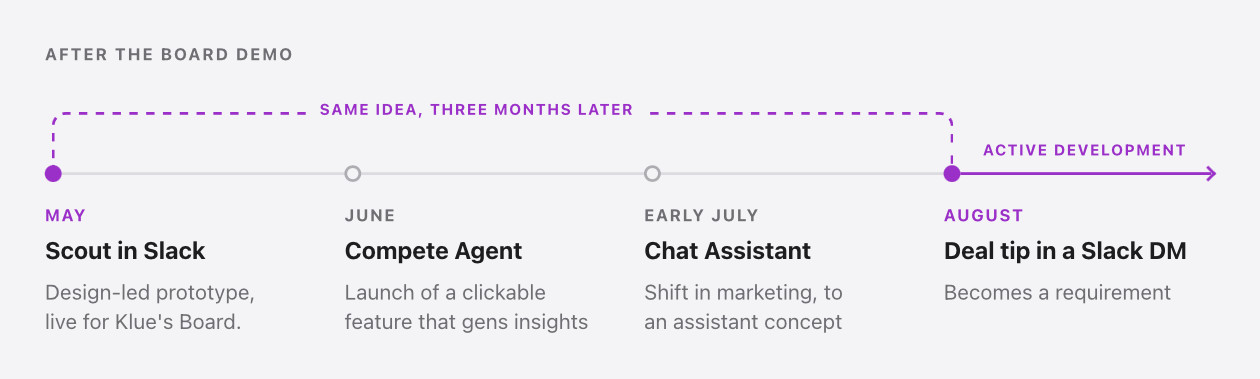
Klue launched Compete Agent in June as a point-and-click tool and, by early July, marketed it as a chat assistant. By August, one of the CEO’s required flows was Scout’s core idea: a seller getting a deal tip in a Slack DM. Chat development continued from there.
15
scripted steps the demo could follow, with open-ended questions woven in.
10
prompts in the pipeline, one for each step from the call to the insight.
1
sales call was used to generate every insight Scout delivered.
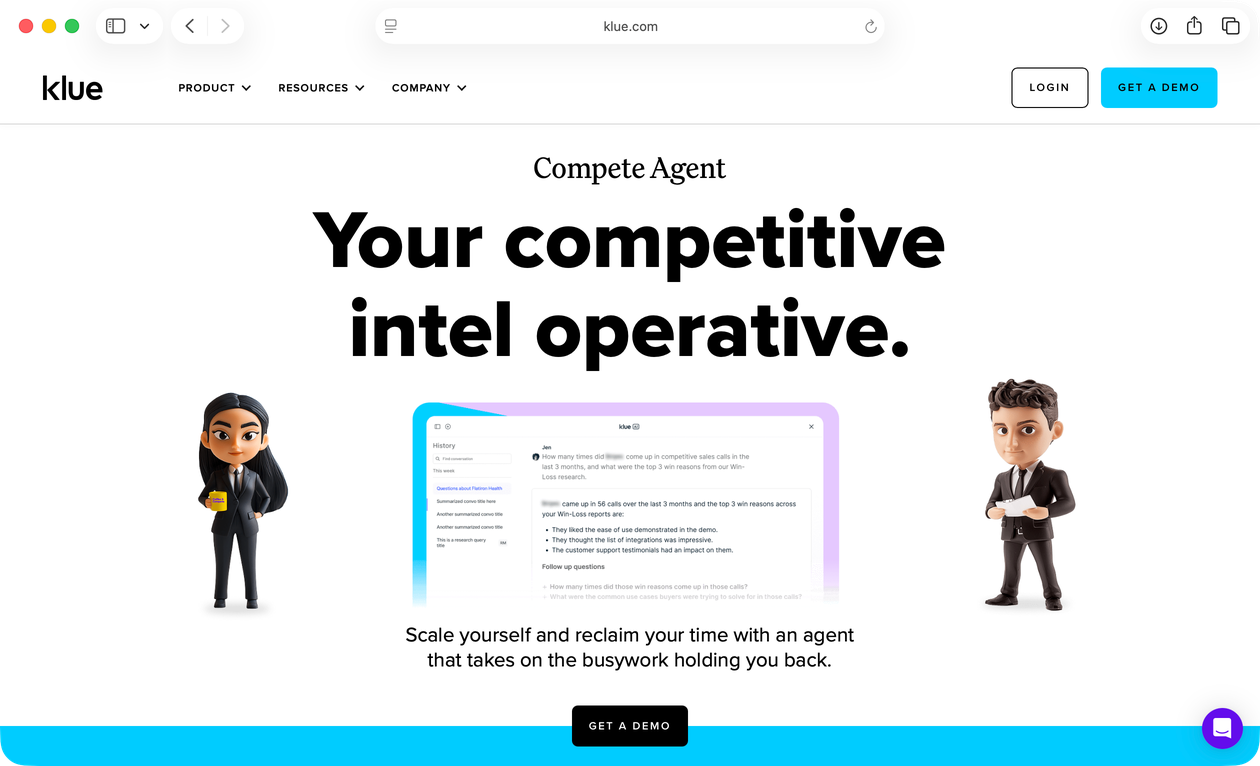
Klue’s Compete Agent, on klue.com. Sellers ask it about the competition and get answers back.
My take
Sometimes you have to build the argument.
I’d long believed insights should arrive as documents, not screens. Scout showed it, live, the board agreed and the company shifted direction.
Questions? Answers.
-
What was Scout, exactly?
A working prototype of a teammate in Slack for sellers. It turned a sales call into insights and the documents behind them, and it ran live for Klue’s board on a scoped set of sandbox data.
-
Did you design it, or build it?
Both. I led the February design sprint with Klue’s design team. Then I designed and built Scout myself: the prompts, the content they generated, the scripted story and the bot. In May I ran the demo.
-
How did you know it could be built?
Building it was the test. Each step of the pipeline was a prompt run on the sales call. Where its output held up, that piece was proven, and the next was built on top. When the pipeline had written all of the demo’s content, the design had been shown to work, and the first step had already worked on real discovery calls.
-
How long did it take?
The sprint and a first Figma demo were in February 2025. The pipeline came next, and its content went into a refined Figma demo. I built the bot in May and tested it over two weeks, and ran it for the board the same month.
-
How is Scout different from futrbot?
Scout was a Klue prototype, for Klue’s board, in 2025. It brought competitive intelligence to sellers in Slack. futrbot came a year later: a personal project built on OpenClaw.
-
What happened after the demo?
Klue’s engineers began building chat-based infrastructure. Scout was the prototype; the product work that followed was theirs. The discovery-notes step kept running on real calls: a Zap posted notes to Slack after each new discovery call.

Search design.